Linked Lists: Comprehensive Guide
DS
Debangsu Sarkar
December 12, 2025•5 min read
development
1. Blog Overview
Goal: Teach beginners everything about Linked Lists to confidently solve common data structure and algorithm interview problems.
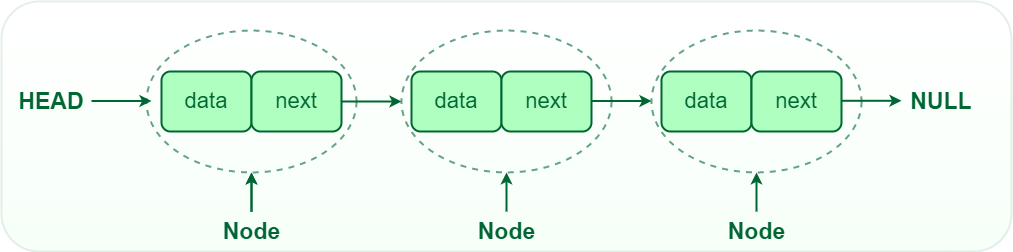
2. Linked List Fundamentals
| Concept | Description | Importance |
|---|---|---|
| Node | A container for data (strings, numbers, booleans, objects). Conceptually visualized as a circle. | Core Concept |
| Link | A pointer from one node to the next node in the sequence (e.g., A's next is B). | Core Concept |
| Linked List | A collection of many nodes linked together in a sequence. | Core Concept |
| Last Node | The final node in the list. Its next pointer is set to null or None, signifying the end. | High |
| Head | The very first node of the linked list. | High |
| Tail | The very last node of the linked list. | High |
| Ordered Data Structure | A key characteristic allowing sequential traversal by following next pointers from head to tail. | High |
| Node Position | Positions are typically zero-indexed (Head is at index 0). | Medium |
3. Comparison: Linked List vs. Array
| Feature | Array | Linked List | Importance |
|---|---|---|---|
| Memory Storage | Must be stored contiguously (blocks right next to each other in memory). | Non-contiguous (nodes can exist anywhere in memory, linked by pointers). | Critical Distinction |
| Insertion at Index | Requires shifting all subsequent elements to make space. | Requires only adjusting pointers (specifically two pointers). | Critical Distinction |
| Insertion Time Complexity | $O(N)$ (Worst case: inserting at index 0 requires shifting all $N$ elements). | $O(1)$ (Constant time, assuming you already have the reference to the insertion point). | Critical Distinction |
4. Core Linked List Algorithms
A. Traversal (Visiting Every Node)
- Core Idea: You only need a reference to the head node to access the entire list.
- Mechanism: Use a
currentvariable (pointer), starting at thehead. In a loop, setcurrent = current.nextuntilcurrentisnull/None.
-
Iterative Solution
- Uses a
while current is not None:loop. - Inside the loop, print
current.valand updatecurrenttocurrent.next.
- Uses a
-
Recursive Solution
- Base Case (Stopping): If
headisNone, return (handles end of list or empty list). - Recursive Step: Print
head.val, then recursively call the function onhead.next.
- Base Case (Stopping): If
B. Linked List Values (Return all values in an Array)
Problem: Given the head, return a list (array) containing all node values in the correct order.
Complexity Analysis
- Time Complexity: $O(N)$ (Must visit every node once).
- Space Complexity: $O(N)$ (Required to store the output list of values).
-
Iterative Solution
- Initialize an empty list/array.
- Use a
whileloop to traverse. - Append
current.valto the values list. - Move
current = current.next. - Return the list after the loop finishes.
-
Recursive Solution (Using Helper Function)
- Why a helper? To maintain the state of the
valueslist without creating new list copies in every stack frame. - Structure:
- The main function initializes an empty
valueslist. - Calls a recursive helper function:
fill_values(head, values).
- The main function initializes an empty
- Helper Logic:
- Base Case: If
headisNone, return. - Recursive Step: Append
head.valtovalues, then callfill_values(head.next, values).
- Base Case: If
- Why a helper? To maintain the state of the